

01 / UNDERSTAND
What is oak wilt?
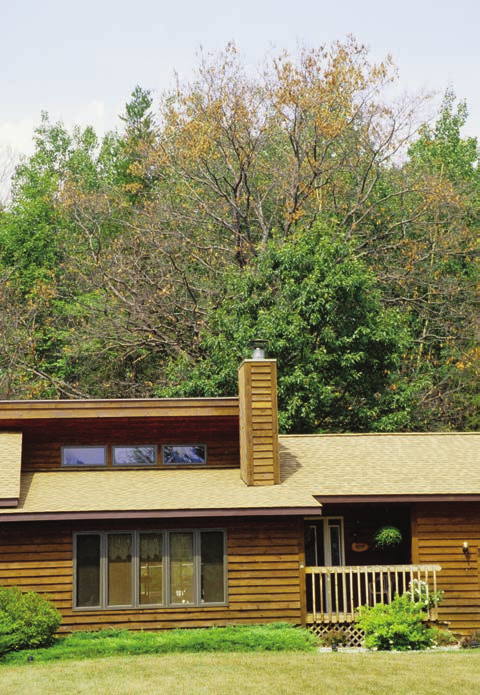
Oak wilt is a vascular disease caused by the fungus Bretziella fagacearum. It interferes with water movement inside the tree. A healthy-looking oak can become infected; this is not simply a disease of weak or neglected trees. [6]
Different oaks respond differently
| Oak group | Examples & identification clue | What infection can mean |
|---|---|---|
| Red oak group | Northern red, black and northern pin oak. Lobed leaves have pointed, bristle-tipped ends. | Highly susceptible. Decline can be rapid, with death within weeks after symptoms appear. |
| White oak group | White, bur and swamp white oak. Common lobed leaves have rounded ends without bristles. | Generally more resistant, but not immune. Disease can progress more slowly; response varies by species and tree. |
Leaf shape is a useful starting clue for these common Michigan species, not a complete identification key. Confirm the species before making treatment decisions. [1] [6]
02 / TRANSMISSION
Two pathways.
One connected problem.
1 Above ground: beetles and fresh wounds
Sap-feeding beetles can pick up spores from fungal mats beneath the bark of infected oaks, especially red oaks. When a beetle visits a fresh wound on another oak, it can introduce the fungus. Pruning cuts, storm breaks and equipment injuries can all provide an entry point. [6]
2 Below ground: connected roots
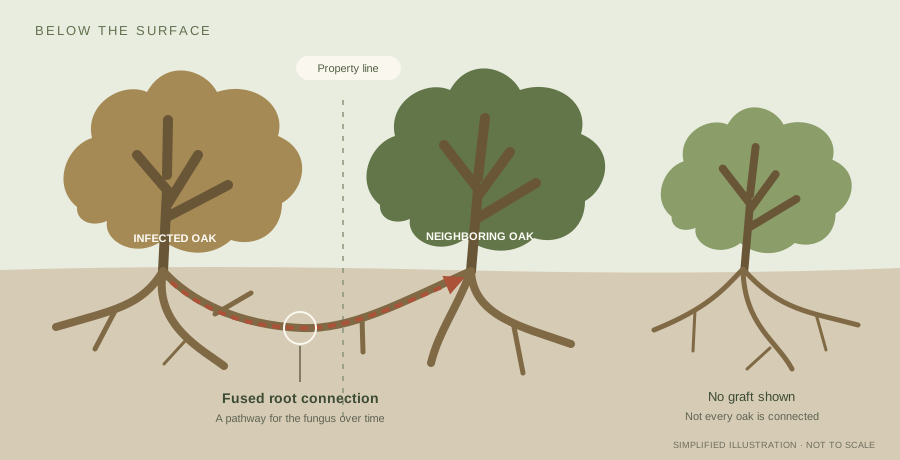
Nearby oaks sometimes form natural root grafts: living connections between their root systems. The fungus can move through those connections and expand an infection beyond the first tree—even across a property line. Not every neighboring oak is connected, and roots that merely cross are not necessarily grafted. [8]
Firewood can carry the source to a new place
Infected oak logs with bark can support spore-producing mats. Moving that wood can bring the fungus into reach of beetles in another neighborhood or campground. The wood does not have to touch a living tree. [1]
03 / RECOGNIZE
Warning signs to take seriously.
- Sudden wilting or browning during the growing season. On a red oak you may first see flagging, where a few branches turn brown; within weeks the entire crown can be brown. A tree killed the year before stands bare.
- Early leaf drop, including partly green leaves, while surrounding trees are still in leaf.
- Rapid change or a developing cluster of declining oaks. A pattern involving neighboring trees deserves investigation. [5] [6]
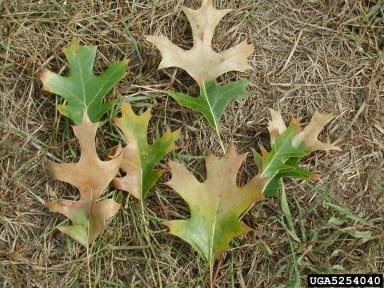
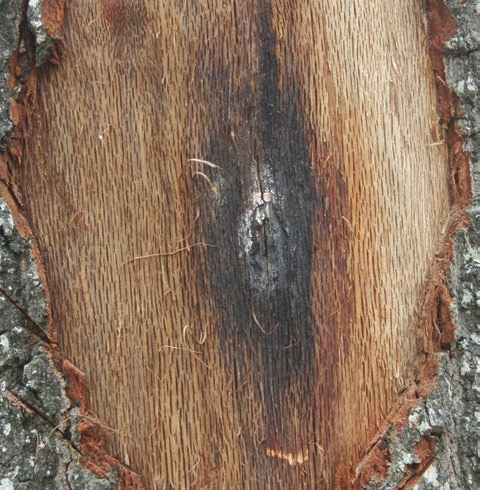
Not every infected tree has an obvious fungal mat. Its absence does not rule out oak wilt. Do not peel bark or cut living branches simply to search for one. [8]
Several problems can look similar
Drought and root-related stress, anthracnose, bacterial leaf scorch, two-lined chestnut borer and other causes of oak decline can overlap with these symptoms. The season, speed of change, tree species, site history and test results matter. A photograph alone should not be the basis for an expensive containment plan. [8] [9]
04 / DIAGNOSIS
Confirm what you’re dealing with.
An examination and appropriate laboratory testing can distinguish oak wilt from other problems. A qualified professional may also recognize a characteristic fungal mat. Get confirmation before committing to disease-specific work. [9]
Testing may start with fallen leaves.
MSU Plant & Pest Diagnostics now provides a leaf-sampling option. Its current instructions call for 15–20 recently fallen leaves with their petioles—the leaf stalks—still attached, showing a mixture of tan and green tissue. Collect beneath the suspect tree and within about 20 feet, taking care not to mix leaves from neighboring trees. [3]
Keep petioles attached and place the leaves in a resealable plastic bag. Follow the laboratory’s current handling and shipping directions. Contact the lab before collecting if the tree is fully dead, the leaves are dry, or suitable leaves are unavailable; branch sampling or another approach may be necessary. [3] [4]
Read MSU’s current sampling instructions ↗A negative result needs context
A poor, dried-out or unrepresentative sample can miss an infection. If the symptoms and site pattern remain concerning, discuss whether further sampling is needed instead of treating one negative result as an all-clear. [10]
Include the tree’s location, species if known, symptom timeline and photographs. Confirm current fees, submission forms and delivery instructions directly with the lab.
05 / PREVENTION
The right season matters.
Plan routine oak pruning for winter dormancy. Michigan DNR identifies April 15 through July 15 as the high-risk period for infection through fresh wounds. Its April 2026 guidance notes that infection risk peaks in May and June. [1]
A Michigan oak-work calendar
SELECT A MONTHAvoid elective pruning and other wounds. May and June are the peak-risk months noted in Michigan DNR’s 2026 guidance.
Typical winter planning monthsHigh risk: Apr 15–Jul 15
This is seasonal guidance, not a real-time risk forecast. Dormancy and weather matter. July 16 is not an automatic all-clear; lower risk is not zero risk. [1] [2]
Protect more than the branches
Plan landscaping, construction and nearby tree removals to avoid bark scrapes, broken branches and root injuries. Discuss oak-wilt precautions with everyone working around your oaks before work begins. [2]
When a fresh wound cannot be avoided
During the high-risk period, Michigan DNR recommends immediately covering fresh oak wounds with latex-based paint or tree-wound paint. This is a specific exception to ordinary wound-care advice. It reduces exposure to beetles; it does not cure an established infection or make summer pruning a preferred choice. Arrange professional help for wounds that cannot be reached safely. [1]
The Michigan Oak Wilt Coalition advises immediate wound protection during both high- and lower-risk periods. Follow current local guidance for unavoidable work outside winter. [11]
06 / MANAGEMENT
A removal is only one part of the plan.
A confirmed infection calls for a plan for the site, including oaks that still look healthy. The order of work matters. Where root separation is needed, it should generally happen before the infected tree is removed. Simply felling the tree leaves the root connections in place. [11]
Map the trees and plan containment
Identify affected oaks, nearby susceptible trees, property boundaries, access and underground utilities. An experienced oak-wilt professional should decide where and how root connections need to be disrupted. There is no universal trench distance that fits every property. [9]
Protect selected trees when appropriate
Professional propiconazole injections can protect selected healthy, at-risk oaks for a limited period. Repeat treatments may be needed. They do not replace root-graft disruption or protect an entire neighborhood through a single injected tree. Use a qualified applicator and the current product label. [7]
Can an infected oak be saved?
A red oak already showing oak-wilt symptoms is not a good candidate for rescue treatment. Therapeutic injections frequently fail. The practical priority becomes protecting nearby oaks.
Some white oaks with early, limited symptoms may benefit from treatment. Species, extent of infection and timing matter. That is a professional case-by-case decision, not a guaranteed cure. [7]
Watering, mulch, fertilizer and root-collar excavation are not substitutes for oak-wilt containment. Root-collar excavation and specialized root-graft disruption serve different purposes.
07 / FIREWOOD & REMOVALS
Be deliberate about where the wood goes.
Do not sell, give away or transport untreated wood from an oak-wilt-killed tree as ordinary firewood. Agree on a wood-handling plan before removal, including who is responsible for processing, disposal and any covering that must stay in place. [12]
- Keep firewood local. Buying near where it will be burned reduces the chance of moving tree pests and diseases.
- Use an appropriate processing or disposal method. Options can include thorough debarking, chipping, approved disposal or permitted on-site burning. Timing and site conditions matter. [1]
- A loose tarp is not containment. Where covering is prescribed, the wood must be fully enclosed to exclude beetles, with edges sealed to the ground and the covering maintained for the required period. Get the exact instructions from the professional managing the site. [12]
Do not assume wood is ready to move simply because it looks dry, has been split, or has sat through part of a winter. Have its condition and treatment confirmed.
08 / THE BIGGER PICTURE
Think beyond the property line.
Talk with your neighbors early
Share the diagnosis and the proposed plan when nearby oaks may be involved. A boundary on a map does not separate roots. Cooperation can make access, containment and follow-up more practical. [8]
Understand what an estimate includes
Oak-wilt work may involve diagnostic visits and testing, specialized root disruption, treatment of selected trees, removals, wood handling and future inspections. Ask for those items to be identified separately, including repeat-treatment obligations. Tree size, the number of trees, terrain, access and utilities can change the scope substantially.
The financial impact also includes what a lost mature tree provided: shade, screening and landscape character. Those losses are different from the contractor’s bill. A single generic “oak wilt treatment price” cannot describe every site. [13]
Plan the next generation of shade
After containment is addressed, choose replacement trees for the actual soil, space and growing conditions. A diverse mix reduces dependence on one susceptible group. Discuss where new oaks belong within the long-term site plan. [7]
09 / COMMON QUESTIONS
The questions worth asking.
My oak is dropping leaves in October. Is that oak wilt?
Fall leaf drop by itself is not evidence of oak wilt. Look at when the decline began, how quickly it progressed and whether unusual symptoms appeared during the growing season. If the pattern concerns you, have it evaluated rather than diagnosing from leaf color alone. [5]
My oak was pruned in summer. Is it definitely infected?
No. A fresh wound can create an opportunity for infection; it does not prove that infected beetles visited it. Record the date, seek advice about any fresh wounds and watch for changes. Plan future elective work for winter. [2]
Should I cut down a dying oak right away?
Get prompt help, but arrange the disease-management sequence before routine removal. If the tree poses an immediate danger, tell the responding professional about the suspected disease so both issues can be addressed. [9] [11]
Do healthy-looking nearby oaks need attention?
Yes. Appearance alone cannot establish whether a neighboring tree is exposed or whether its roots are connected. Ask which trees belong in the assessment and monitoring plan. It does not mean every nearby oak needs injection or removal. [7]
Does stump grinding stop underground spread?
Ordinary stump grinding is not equivalent to severing connected root systems. Do not treat it as a replacement for professionally designed containment. [8]
The map shows no oak wilt near me. Am I in the clear?
No. The map is a record of reported and investigated locations, not a test of your trees. Use it as context and continue prevention and observation. You can report a suspected location through the Michigan DNR tool. [5]
10 / A SENSIBLE NEXT STEP
Let’s start with
what you’re seeing.
I’m Jeremy Slot, ISA Certified Arborist MI-4072A and owner of The Tree Stylist. My approach begins with understanding the tree and its setting, explaining the findings, and helping you choose an appropriate next step.
If you are concerned about an oak, send photographs and describe what changed. I can help with tree diagnostics, consultation and planning winter pruning. If the situation calls for specialized testing, injections or root-graft containment, we can discuss the expertise the work requires.
Tell me about your oak (231) 580-4282Serving Montcalm, Mecosta, Newaygo, Isabella, Kent and surrounding West Michigan counties. Towns served: Greenville, Big Rapids, Mt. Pleasant, Stanton, Canadian Lakes, Newaygo, Rockford, Sparta.
THE EVIDENCE BEHIND THE GUIDE
Sources & photograph credits
Sources checked October 25, 2026. Michigan sources govern seasonal advice; regional sources support disease biology and treatment context. Older publications are used for established background, not as replacements for current laboratory instructions or product labels.
- Michigan DNR — Put that saw down! Delay pruning oaks until mid-JulyApril 13, 2026 · Michigan pruning dates, peak risk and fresh-wound precautions.
- Michigan DNR — Protect your oak trees; prune before springNovember 13, 2024 · Winter preference and risk outside the main window.
- MSU Plant & Pest Diagnostics — Oak wilt sample submissionCurrent instructions · Leaf collection and laboratory submission.
- MSU Extension — New research puts oak wilt testing within reach of homeownersSeptember 10, 2024 · Leaf-petiole testing and handling.
- Michigan Invasive Species Program — Oak wiltIdentification, reporting and the Michigan map. Leaf photograph: Joseph O’Brien, USDA Forest Service, Bugwood.org, image 5254040, licensed CC BY 3.0 US (https://creativecommons.org/licenses/by/3.0/us/).
- Wisconsin DNR — Oak wiltDisease biology, oak-group response and management principles. Wisconsin pruning calendars are not substituted for Michigan guidance.
- University of Minnesota Extension — Oak wilt in MinnesotaReviewed 2026 · Treatment limitations, connected roots and integrated management.
- USDA Forest Service — How to Identify, Prevent, and Control Oak Wilt2011, NA–FR–01–11 · Background biology, look-alikes and containment. Cover photograph and Figure 4 reproduced from this federal publication.
- Ruth Dorando Marcy / ISA Michigan — Control and Management of Oak Wilt in Residential SettingsJanuary 2019 · Diagnosis and sequencing context. Use current sources for sampling, pesticide directions and wood-covering specifications.
- MSU Extension — The best sampling procedures for accurate oak wilt testingApril 28, 2021 · Sample quality and false negatives; current leaf-sampling instructions are linked above.
- Michigan Oak Wilt Coalition — Residential / Municipal guidanceRoot separation before removal and wound precautions.
- University of Wisconsin Plant Disease Diagnostics Clinic — Oak wiltRevised March 20, 2024 · Infected wood and beetle exclusion. Michigan sources govern local work timing.
- Michigan Oak Wilt Coalition — Oak Wilt Basics, introductionDistinguishing management expense from tree and property-value losses.
The root-graft diagram is an original explanatory illustration. The Oak Wilt emblem is a conceptual illustration, not a diagnostic photograph. The video and its thumbnail belong to The Tree Stylist. Reference photographs are not presented as Tree Stylist client projects. This guide supports informed decisions; it does not diagnose an individual tree.